papermodelsonline
California Mission San Miguel - Paper Model Project Kit
California Mission San Miguel - Paper Model Project Kit
- Clear Project Instructions
- Real Finished-Model Photos
- Project and Report Help
Couldn't load pickup availability
Product details, history and report starting point
California Mission San Miguel School Project Kit
Build a detailed paper model of Mission San Miguel Arcángel for a California history report, classroom display, or school project. The finished model shown in the product photos was built from this kit.
- Two sizes: 7" × 10" and 10" × 13"
- Two delivery choices: instant PDF download or pre-printed kit shipped to you
- Easy to assemble: cut, fold, and glue the clearly marked pieces
- Report help included: a concise history of Mission San Miguel provides a useful starting point for student research
- Typical build time: about 90 minutes to two hours
Choose your kit
Select a size and delivery method above. The 10" × 13" Download option is selected first because it gives students a larger finished project while still printing on standard 8½" × 11" paper. Its base prints in sections that are joined during assembly.
Download orders provide a printable PDF after checkout. Pre-printed kits are produced on sturdy cardstock and shipped within the continental United States. A flat $6 shipping charge is added automatically to shipped orders.
You will need scissors and glue. Regular printer paper works, although cardstock produces a stronger model. Adult supervision is recommended when children use scissors.

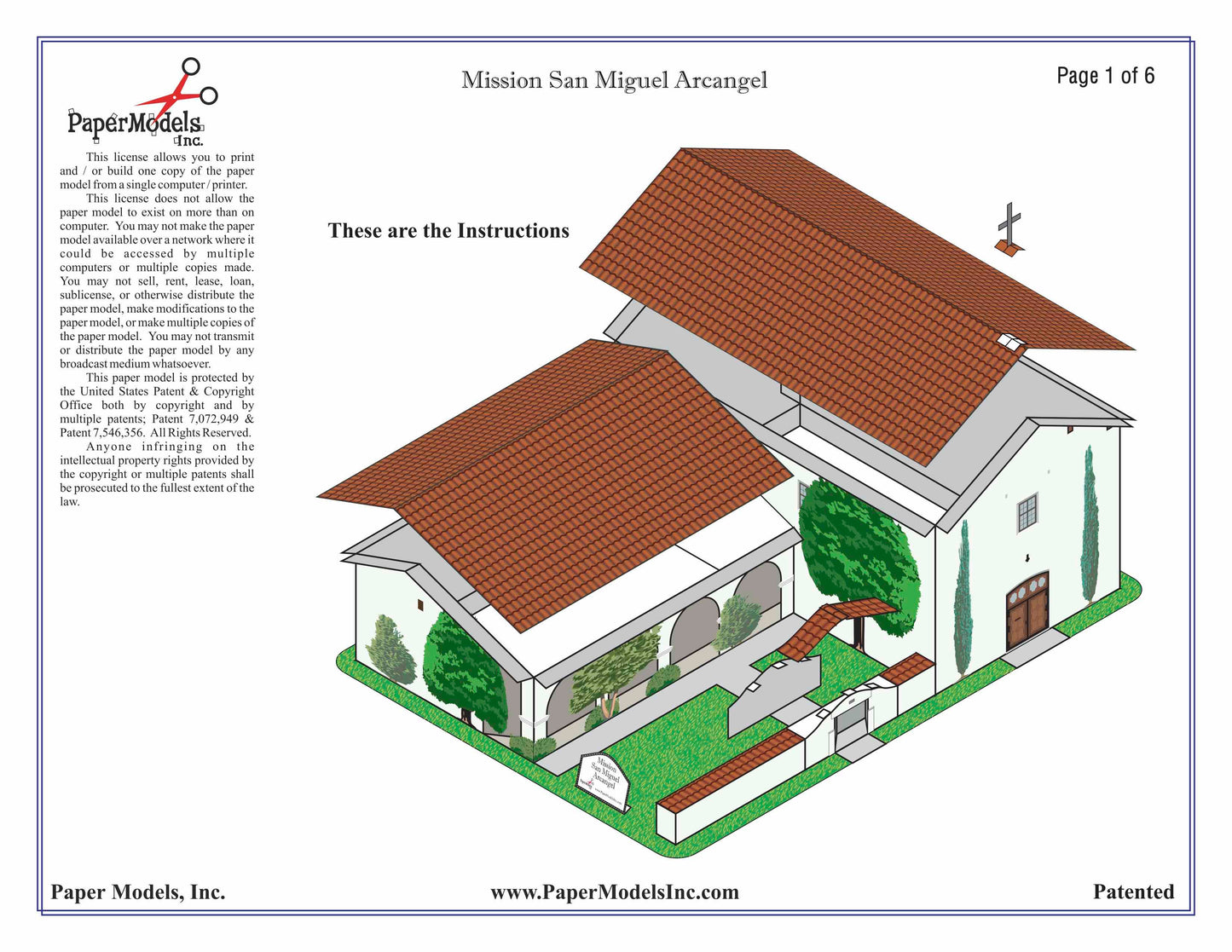
What is included
Each kit contains the printable model pieces, an exploded assembly view, and background history for a student report. Depending on the selected size, the kit contains approximately 8 to 18 printable pages.
 |
 |
 |
| Exploded view | Sample pieces | Finished model |
Mission San Miguel Arcángel History for Your Report
Mission San Miguel Arcángel, Saint Michael the Archangel
Mission San Miguel Arcángel was the 16th Spanish mission founded in California. Friar Fermín Lasuén founded it on July 25, 1797. It was named for Saint Michael the Archangel.
The mission was established to fill the long distance between Mission San Antonio de Padua and Mission San Luis Obispo de Tolosa. Its site was in a valley near the Salinas and Nacimiento rivers. Many local Native American families attended the first service, and construction began soon afterward. A church and small village developed around the mission.
A larger church replaced the first building about a year later. Both early churches had mud roofs and simple construction. A fire in 1806 destroyed the church, several other buildings, and supplies used by the community. Nearby missions donated goods, and Mission San Miguel soon resumed its work.
The padres then planned a larger tile-roofed church. Adobe bricks were made for years before formal construction began in 1816. Because so much material had been prepared in advance, the church was completed two years later.
Esteban Munrás, an artist from Catalonia, Spain, decorated the church with the help of Native American artisans whom he trained. Their colorful designs remain one of the mission's most distinctive features.
Mission San Miguel once controlled land along roughly 50 miles of the Salinas River and operated a rancho near San Simeon. In 1834, secularization transferred much of the mission property. The mission remained active until 1846. Shortly before the United States took control of California, Governor Pío Pico sold most of the property except the church and priests' quarters.
William Reed later occupied part of the mission with his family. In 1848, Reed, his family, and members of the household were killed by travelers who believed treasure was hidden on the property. A posse pursued the attackers, and the surviving suspects were later executed in Santa Barbara.
The buildings subsequently served several commercial uses, including a saloon on El Camino Real. Mission properties were returned to the Catholic Church in 1859, although restoration at San Miguel did not begin until later. The Franciscans returned in 1928. Today the mission serves as a parish church and monastery, and visitors can still see surviving historic artwork and evidence of the building's long history.
This overview is a starting point. Students should confirm dates and details with teacher-approved primary and secondary sources before submitting a report.
© Paper Models, Inc. All rights reserved.