Paper Models, Inc.
Hydro-Electric Renewable Energy Paper Model Kit - Series
Hydro-Electric Renewable Energy Paper Model Kit - Series
- Clear Project Instructions
- Real Finished-Model Photos
- Project and Report Help
No se pudo cargar la disponibilidad de retiro
Product details, history and report starting point
Hydro-Electric Renewable Energy Paper Model Kit
Build a hands-on hydroelectric dam school project that helps students understand how moving water creates clean, renewable electricity.
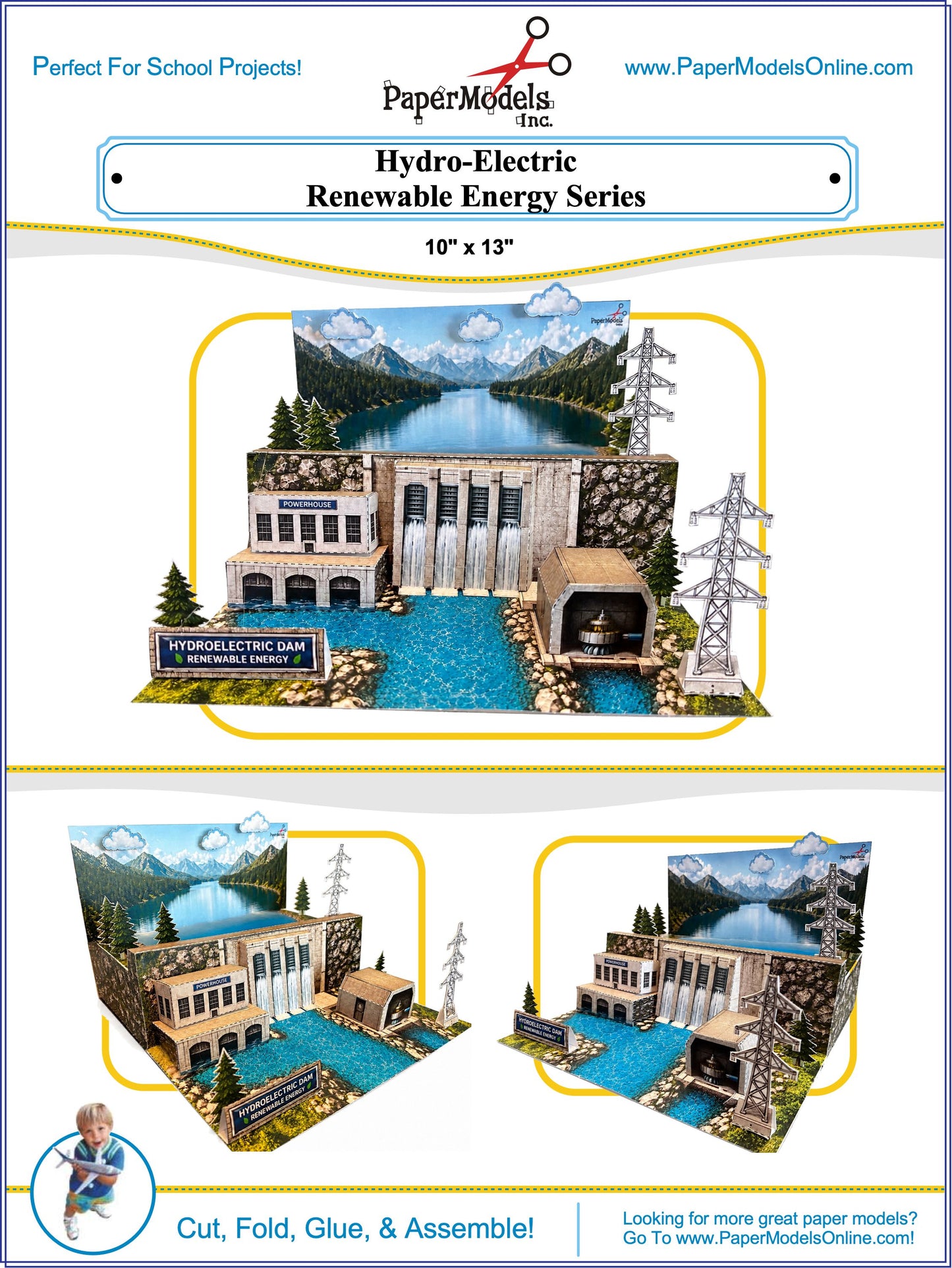
The Hydro-Electric Renewable Energy Paper Model Kit is a printable 3D paper model designed for students, parents, teachers, homeschool families, and classroom science projects. This educational kit helps bring hydroelectric power to life by showing the major parts of a working hydroelectric dam, including the reservoir, spillway, powerhouse, turbine area, generator concept, power lines, flowing water, rocky landscape, trees, and mountain lake backdrop.
Instead of starting from scratch with cardboard, paint, glue, and a stressful trip to the craft store, students can download, print, cut, fold, and assemble a professional-looking hydroelectric dam display. The finished model gives students a strong visual centerpiece for a renewable energy report, science fair display, classroom presentation, or environmental science lesson.
Hydroelectric energy can be difficult for students to understand from a textbook alone. This model makes the process easier to see. Water is stored behind the dam in a reservoir, released through the dam, directed through the power system, used to spin turbines, and converted into electricity that travels through power lines to homes, schools, and communities. By building the model, students can better explain how water, gravity, turbines, generators, and power lines work together to create renewable energy.
This kit is especially helpful for school projects because it combines art, science, engineering, and environmental education in one finished display. Students can use the model as the main visual part of their project, then add their own written report, labels, facts, presentation notes, and creative details. Parents can reduce the hardest part of the project, while still giving the student plenty of opportunity to learn, assemble, decorate, and explain how hydroelectric power works.
The Hydro-Electric Renewable Energy Paper Model Kit is ideal for renewable energy units, environmental science lessons, STEM activities, engineering demonstrations, Earth science projects, water cycle lessons, and classroom displays. Teachers can use it to help students compare different renewable energy sources, including hydroelectric power, solar energy, wind turbines, and geothermal energy. Students can use it to show why hydroelectric power is considered renewable, how reservoirs store potential energy, how turbines convert moving water into mechanical energy, and how generators turn that motion into electricity.
The finished model is designed to look like a miniature hydroelectric power exhibit. It includes a scenic mountain reservoir backdrop, a realistic dam wall, flowing spillway water, a powerhouse building, a turbine structure, transmission towers, trees, rocks, water channels, and educational signs that help explain the process. The model creates a stronger presentation than a flat poster because students can point to the parts of the dam and explain what each part does.
This downloadable paper model kit is a smart choice for busy families because it saves time while still creating an impressive, educational result. Once printed, the pieces can be cut, folded, glued, and assembled into a colorful 3D display. Students can then focus their creative energy on improving the diorama, adding labels, writing their report, practicing their presentation, and learning the science behind hydroelectric renewable energy.
A good hydroelectric dam school project should show more than just a dam. It should explain how stored water becomes moving water, how moving water spins a turbine, how the turbine powers a generator, and how electricity is sent through power lines. This kit helps students tell that complete story in a clear, visual, and memorable way.
Perfect For
This kit is perfect for elementary school science projects, renewable energy reports, STEM lessons, homeschool activities, environmental science units, classroom demonstrations, science fair displays, water energy projects, engineering projects, and students learning how hydroelectric dams work.
What Students Learn
Students learn what hydroelectric energy is, how a dam stores water in a reservoir, why gravity gives stored water potential energy, how flowing water moves through a hydroelectric system, how turbines and generators create electricity, how power lines carry electricity to communities, and why hydroelectric power is considered renewable.
Why Parents And Teachers Like It
Parents like this kit because it makes the project easier, faster, and less stressful while still allowing the student to build something impressive. Teachers like it because it gives students a visual way to explain science concepts instead of simply reading from a report. Students like it because the finished model looks detailed, colorful, and fun to present.
Download, Print, Build, and Learn
The Hydro-Electric Renewable Energy Paper Model Kit gives students a better way to understand renewable energy by turning a complex science topic into a hands-on 3D learning experience. It is more than a craft project. It is a complete visual explanation of how moving water can become clean electricity.
Add this hydroelectric dam paper model kit to your school project today and help your student build a renewable energy display they can proudly explain.
At PaperModelsOnline, you can instantly download the model and print it yourself!
🌟 Welcome to Paper Models Online – Your Shortcut to Academic Excellence! 🌟
Are you tired of stressing over last-minute school projects? Look no further! Paper Models Online is here to make your academic life a breeze.
🚀 Why Choose Us?
At Paper Models Online, we understand the pressure of looming deadlines and the desire for that coveted "A" grade. That's why we've crafted the perfect solution for you! Whether you're a student aiming for extra credit, a parent looking for quality time with your kids, or just someone in need of a break from the chaos, our paper models are your ticket to success!
💻 Instant PDF Download OR Pre-Printed & Shipped
You're in control! Choose from our instant PDF download, starting at just $9.95 for the 7"x10" size or $11.95 for the 10"x13" size.
Print it on your home or office printer using regular paper, or opt for the hassle-free pre-printed option. We'll ship it directly to your doorstep for a flat fee via USPS First-Class Parcel, ensuring you get it in 1-3 days!
✂️ Easy Assembly, Maximum Impact
With just a pair of scissors, some glue, and an hour of your time, you can turn these paper sheets into stunning three-dimensional architectural replicas or complete science projects. The images on our website are real models made from our kits, and we even provide a history to help you craft an impressive report.
🎨 Unleash Your Creativity
Not into mission kits? No worries! Our models double as templates for your creative genius. Paint, trace, adjust sizes—your imagination is the only limit! Create a custom masterpiece that reflects your unique style and personality.
🛒 The Buying Process Made Simple
- Choose Your Size: 7"x10" or 10"x13"
- Choose Your Delivery: Instant PDF download or pre-printed and shipped
- Purchase Your Model: It's that easy!
📦 Typical Kit Sample
Each kit includes 8 to 18 pages, providing everything you need to bring the model to life. An "exploded view" guides you through assembly, and a complementary history adds that extra touch for your report. Impress your teacher not just with creativity but also with your research skills!
Don't let deadlines stress you out. Choose Paper Models Online for your next school project, and let us be Your Best Way To Get An "A"!
Hydroelectric Energy
What It Is, How It Works, and Why It Is Renewable
Hydroelectric energy is electricity made from moving water. The word “hydroelectric” combines “hydro,” meaning water, and “electric,” meaning electricity. A hydroelectric dam uses the natural movement and weight of water to generate power for homes, schools, businesses, streetlights, and communities. Instead of burning coal, oil, or natural gas, a hydroelectric power plant stores water behind a dam and releases it in a controlled way so the moving water can turn machines that produce electricity.
A hydroelectric dam is usually built across a river or in a valley where water naturally collects. When the dam blocks part of the river, it creates a large body of stored water called a reservoir. This reservoir is important because it holds water at a higher elevation than the water below the dam. That stored water has potential energy, which means it has energy waiting to be used. It is like a bicycle sitting at the top of a hill. The bicycle is not moving yet, but gravity can pull it downhill. In the same way, water behind a dam has energy because gravity can pull it through the dam.
When electricity is needed, gates inside the dam open so water can flow from the reservoir into large pipes called penstocks. A penstock is like a giant water tunnel that carries water down toward the power-generating equipment. As the water moves through the penstock, gravity makes it flow faster and with more force. This rushing water is directed toward a turbine, which has blades that spin when moving water pushes against them. A turbine works somewhat like a pinwheel, except it is much stronger and is turned by water instead of wind.
The turbine is connected to a generator, which is the part of the system that actually makes electricity. Inside the generator, magnets and coils of wire work together to change motion into electrical energy. When the turbine spins, it causes the generator to spin, and that movement creates electricity. The electricity then travels through power lines to the places where people need it. After the water passes through the turbine, it flows out of the dam and continues downstream. The water is not burned, destroyed, or used up. It simply moves through the system and continues along its natural path.
Another important part of a hydroelectric dam is the spillway. A spillway is a safety feature that allows extra water to be released when the reservoir level gets too high. Heavy rain, melting snow, or storms can add a large amount of water to a reservoir. If too much water builds up behind the dam, it can become dangerous. The spillway helps control the water level and prevents flooding by allowing excess water to flow safely downstream. In a school model, the spillway is often shown as water flowing down the face of the dam, but in a real dam, spillways are carefully engineered to protect the dam, the river, and nearby communities.
Hydroelectric power is renewable because it depends on the water cycle, which is naturally repeated by the Earth. The Sun heats water in oceans, lakes, rivers, and soil, causing some of it to evaporate into the air as water vapor. That vapor cools and forms clouds. Eventually, the water falls back to Earth as rain or snow. Rain and melting snow refill rivers, lakes, and reservoirs, and the process continues over and over again. Because the water cycle keeps replacing the water that flows through rivers, hydroelectric energy can be used again and again as long as there is enough moving water.
Hydroelectric energy is useful because it can produce large amounts of electricity without creating air pollution during operation. A coal or gas power plant must burn fuel to make electricity, and burning fuel can release smoke, carbon dioxide, and other pollutants. A hydroelectric plant does not need to burn fuel to spin its turbines. It uses the force of moving water instead. This makes hydroelectric power a cleaner energy source than many traditional fossil fuel power plants.
Hydroelectric power can also be reliable. Water stored in a reservoir can be released when electricity is needed, so hydroelectric plants can often respond quickly to changes in demand. During a hot afternoon when many people are using air conditioners, a hydroelectric plant may release more water through the turbines to produce more electricity. When less electricity is needed, less water can be released. This ability to control water flow helps balance the electrical grid.
Hydroelectric dams can provide benefits beyond electricity. Reservoirs may store water for farms, cities, and drinking water supplies. They may also help control floods by holding back water during heavy rainstorms and releasing it more slowly. Some reservoirs are used for boating, fishing, and recreation. However, dams must be planned carefully because they can affect fish, wildlife, water temperature, and nearby habitats. Engineers and environmental scientists often work together to design fish passages, manage water releases, and protect river ecosystems.
The basic hydroelectric process can be remembered in five steps. First, water is stored behind the dam in a reservoir. Second, the water flows through a penstock, where gravity pulls it downward with force. Third, the moving water spins a turbine. Fourth, the turbine spins a generator. Fifth, the generator produces electricity that travels through power lines to homes, schools, and businesses.
Hydroelectric energy is one of the oldest and most widely used forms of renewable energy. People have used moving water for thousands of years to grind grain, power machinery, and support communities. Modern hydroelectric dams use the same basic idea, but with advanced engineering and powerful generators. Instead of using water to turn a simple mill wheel, a hydroelectric plant uses water to spin turbines that can produce electricity for thousands or even millions of people.
In the end, hydroelectric energy is renewable because it uses water that is constantly renewed by the water cycle. It works by storing water, releasing it through the dam, spinning turbines, and generating electricity. It is important because it can produce dependable power without burning fuel and can help reduce pollution compared with many nonrenewable energy sources. A hydroelectric dam is a strong example of how science, engineering, and nature can work together to turn moving water into clean, useful energy.