Paper Models, Inc.
Solar Farms - Renewable Energy Paper Model - Series
Solar Farms - Renewable Energy Paper Model - Series
- Clear Project Instructions
- Real Finished-Model Photos
- Project and Report Help
Couldn't load pickup availability
Product details, history and report starting point
Solar Farm – Renewable Energy Series
Download. Print. Build. Learn.
Turn a simple school assignment into a standout, A-level project with the Solar Farm Paper Model Kit from the Renewable Energy Series. This premium, hands-on STEM kit lets students build a realistic solar farm while learning how clean energy works—step by step, piece by piece.
Why This Kit Stands Out
Most school projects explain solar energy with words.
This one shows it in 3D.
Students don’t just read about renewable energy—they build the system themselves, from solar panels to power lines. It’s the difference between reading a map and walking the path.
What Students Will Learn
A great project doesn’t just look good—it teaches something meaningful.
With this kit, students clearly understand:
- How sunlight becomes electricity
- The role of solar panels, inverters, and battery storage
- How power flows through a transformer to the grid
- Why renewable energy matters for the environment
It’s a complete visual story of how a solar farm works—perfect for science fairs, classroom presentations, and STEM learning.
What’s Included
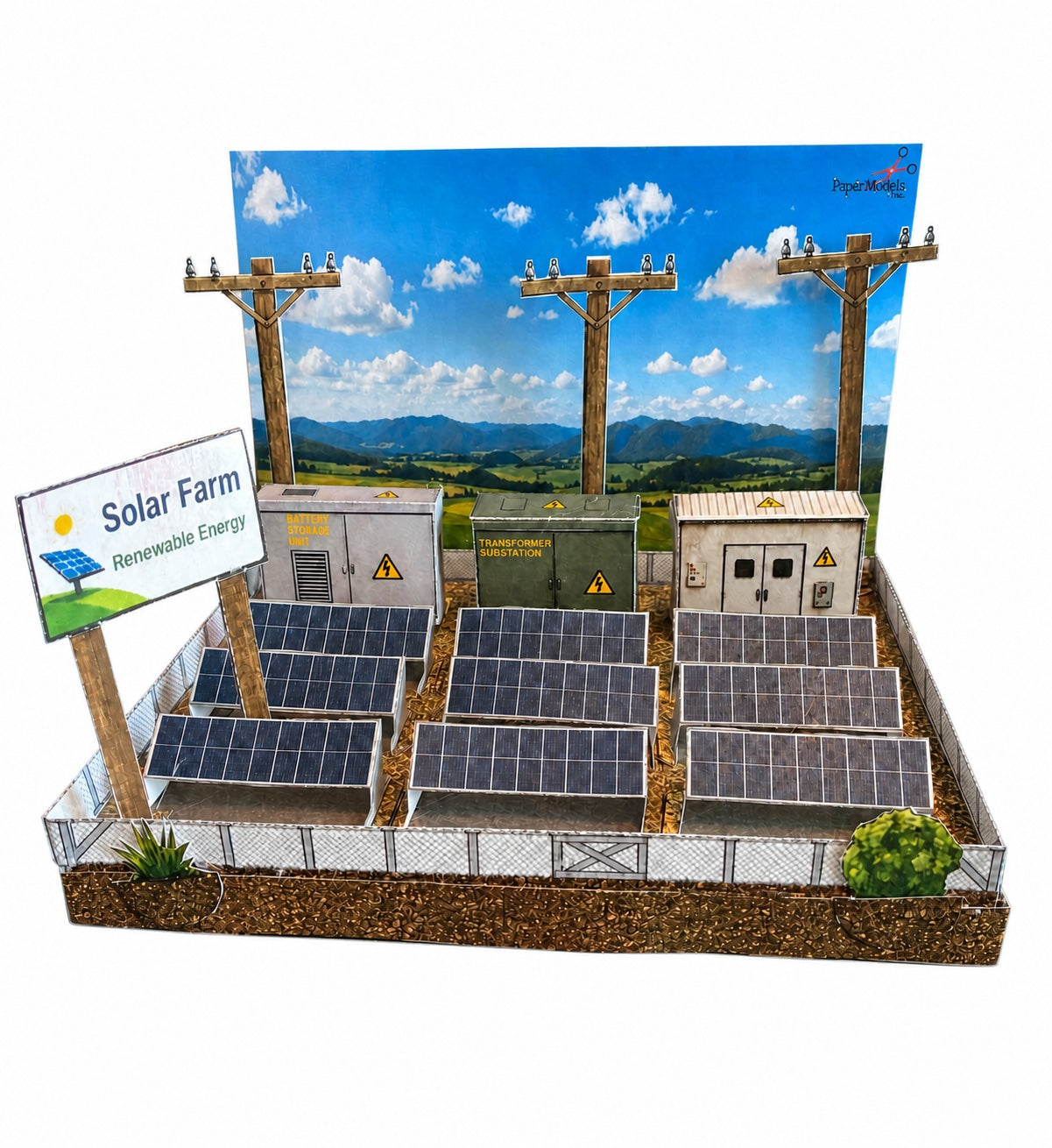
- High-quality, printable 3D solar panel structures
- Realistic inverter, battery storage, and transformer units
- Detailed fencing, utility poles, and power lines
- Scenic landscape base and backdrop
- Clean, labeled components for an organized, professional display
Everything is designed to fit together smoothly, creating a polished, museum-quality model.
Designed for Success
Parents and teachers often ask:
“What’s the easiest way to create a great science project?”
This is it.
The kit removes the most difficult parts of building from scratch, so students can focus on:
- Creativity
- Presentation
- Understanding the science
The result is a project that looks impressive and is easy to explain.
Perfect For:
- Elementary and middle school science projects
- STEM and renewable energy units
- Homeschool activities
- Classroom demonstrations
- Science fairs and presentations
The Smart Shortcut to an “A”
Building a solar farm from scratch can be time-consuming and frustrating.
This kit gives students a clear, structured starting point, saving hours of effort while delivering professional results.
Students can then personalize their project by adding:
- Landscaping and details
- Labels and diagrams
- Written reports and presentations
Why Choose PaperModelsOnline
At PaperModelsOnline, we design models that are:
- Educational first
- Easy to build
- Visually impressive
- Aligned with real classroom expectations
Our goal is simple:
Help students learn faster, build better, and feel proud of their work.
The Easiest Way to Build a Solar Farm Project
A good school project should be clear, creative, and easy to explain.
This kit delivers all three.
👉 Download your Solar Farm – Renewable Energy Series Kit today
👉 Build it in hours, not days
👉 Present with confidence
👉 Stand out in class
🌟 Welcome to Paper Models Online – Your Shortcut to Academic Excellence! 🌟
Are you tired of stressing over last-minute school projects? Look no further! Paper Models Online is here to make your academic life a breeze.
🚀 Why Choose Us?
At Paper Models Online, we understand the pressure of looming deadlines and the desire for that coveted "A" grade. That's why we've crafted the perfect solution for you! Whether you're a student aiming for extra credit, a parent looking for quality time with your kids, or just someone in need of a break from the chaos, our paper models are your ticket to success!
💻 Instant PDF Download OR Pre-Printed & Shipped
You're in control! Choose from our instant PDF download, starting at just $9.95 for the 7"x10" size or $11.95 for the 10"x13" size.
Print it on your home or office printer using regular paper, or opt for the hassle-free pre-printed option. We'll ship it directly to your doorstep for a flat fee via USPS First-Class Parcel, ensuring you get it in 1-3 days!
✂️ Easy Assembly, Maximum Impact
With just a pair of scissors, some glue, and an hour of your time, you can turn these paper sheets into stunning three-dimensional architectural replicas or complete science projects. The images on our website are real models made from our kits, and we even provide a history to help you craft an impressive report.
🎨 Unleash Your Creativity
Not into mission kits? No worries! Our models double as templates for your creative genius. Paint, trace, adjust sizes—your imagination is the only limit! Create a custom masterpiece that reflects your unique style and personality.
🛒 The Buying Process Made Simple
- Choose Your Size: 7"x10" or 10"x13"
- Choose Your Delivery: Instant PDF download or pre-printed and shipped
- Purchase Your Model: It's that easy!
📦 Typical Kit Sample
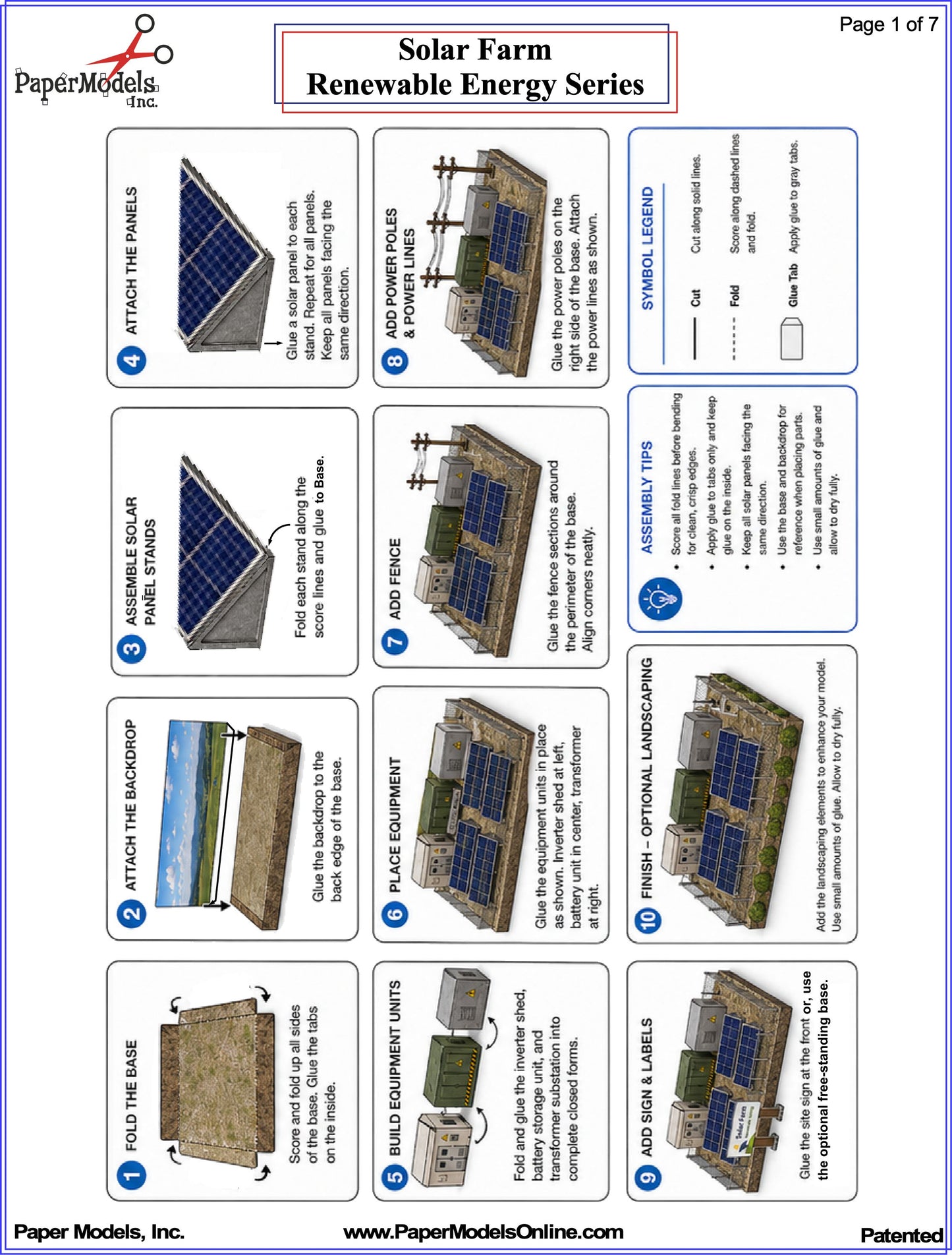
Each kit includes 8 to 18 pages, providing everything you need to bring the model to life. An "exploded view" guides you through assembly, and a complementary history adds that extra touch for your report. Impress your teacher not just with creativity but also with your research skills!
Don't let deadlines stress you out. Choose Paper Models Online for your next school project, and let us be Your Best Way To Get An "A"!
Solar Farms and Solar Energy
A solar farm is a large area of land covered with many solar panels that collect sunlight and turn it into electricity. You can think of a solar farm like a “sunlight garden.” Instead of growing vegetables, it “grows” clean electricity from the Sun. Solar farms are usually built in open areas where there is plenty of sunlight, such as deserts, fields, or large empty spaces near towns and cities. The electricity made by a solar farm can help power homes, schools, businesses, streetlights, and even electric cars.
Solar energy is energy that comes from the Sun. Every day, the Sun gives Earth heat and light. Solar panels are special devices that capture sunlight and change it into electrical energy. The panels are usually dark blue or black because those colors help absorb sunlight. Inside each solar panel are many small parts called solar cells. When sunlight hits the solar cells, it creates an electric current. That electricity can then travel through wires to buildings, batteries, or the power grid. The power grid is the large system of wires, poles, substations, and power lines that carries electricity to people.
A solar farm usually has several important parts that work together to create and deliver electricity. The solar panels collect sunlight and produce electricity. The inverter changes the electricity from the panels into the type of electricity homes and schools can use. A battery storage unit can save extra electricity for later use, especially at night or during cloudy weather. A transformer helps send the electricity safely into the power grid. Fences are often placed around solar farms to protect the equipment, while utility poles and power lines help move the electricity where it is needed.
Solar energy is related to renewable energy because sunlight can be used again and again. Renewable energy means energy that comes from natural sources that do not run out quickly. Sunlight, wind, water, and heat from inside the Earth are all examples of renewable energy sources. Coal, oil, and natural gas are not renewable because once they are used, they are gone. They also create pollution when burned. Solar energy is cleaner because it does not need to burn fuel to make electricity. This helps reduce smoke, air pollution, and greenhouse gases. Greenhouse gases trap heat in Earth’s atmosphere and can contribute to climate change. Using solar energy can help protect the environment and reduce the amount of fossil fuels people use.
Solar farms are especially useful because they can produce a large amount of electricity at one time. One rooftop solar system may help power a single house, but a solar farm can help power hundreds or even thousands of homes depending on its size. Solar farms can also be built in many different places. Some are built on unused land, some are built near farms, and others are built in deserts where there is strong sunlight. Some solar systems are even built over parking lots, where they provide shade for cars while also producing electricity.
There are some challenges with solar energy. Solar panels work best when the Sun is shining, so they make less electricity at night, during storms, or on cloudy days. That is why battery storage is very important. Batteries can store extra energy made during sunny hours so it can be used later when sunlight is not available. Solar farms also require space, careful planning, and regular maintenance. Workers must make sure the panels stay clean and the equipment works safely. Even with these challenges, solar energy is still one of the most important renewable energy sources in the world.
A simple way to explain how solar energy works is this: sunlight hits the solar panel, the solar panel creates electricity, the inverter changes the electricity into usable power, and the power then travels to batteries, homes, schools, or the electric grid. People use that electricity for lights, computers, appliances, and many other everyday needs.
Solar farms are a great example of how science, technology, and nature can work together. They use something free and natural, sunlight, to help create clean power for communities. For a school project, a solar farm model should include solar panels, an inverter, battery storage, a transformer, power lines, fencing, and labels. These parts help show how sunlight becomes electricity and how that electricity travels to people.
Solar energy is important because it helps create a cleaner future. It can power homes and schools while reducing pollution and protecting the environment. Because it is renewable and useful, solar energy is one of the best examples of how people can use science and technology to solve real-world problems.