Paper Models, Inc.
Rock Cycle Mountain STEM Paper Model Kit | Earth Science Project
Rock Cycle Mountain STEM Paper Model Kit | Earth Science Project
- Clear Project Instructions
- Real Finished-Model Photos
- Project and Report Help
No se pudo cargar la disponibilidad de retiro
Product details, history and report starting point
Rock Cycle Mountain STEM Paper Model Kit | Earth Science Project
Build an exciting 3D Earth Science project that brings the rock cycle to life with a volcano, layered rock formations, fossil beds, crystals, a cave, a mine tunnel, an erosion channel, a flowing waterfall, and a glowing magma chamber students can actually see, build, explain, and proudly display.
The Rock Cycle Mountain STEM Paper Model Kit turns one of the most important Earth Science lessons into a hands-on school project that is far more exciting than a flat poster or worksheet, because students do not just read about igneous, sedimentary, and metamorphic rocks; they build a dramatic mountain cutaway that shows how rocks form, change, break down, move, and become new rocks over time.
This printable paper model is designed for students, parents, teachers, homeschool families, and classroom science projects where the assignment calls for a creative rock cycle model, geology project, Earth Science display, STEM activity, volcano project, fossil layer model, or hands-on science fair presentation.
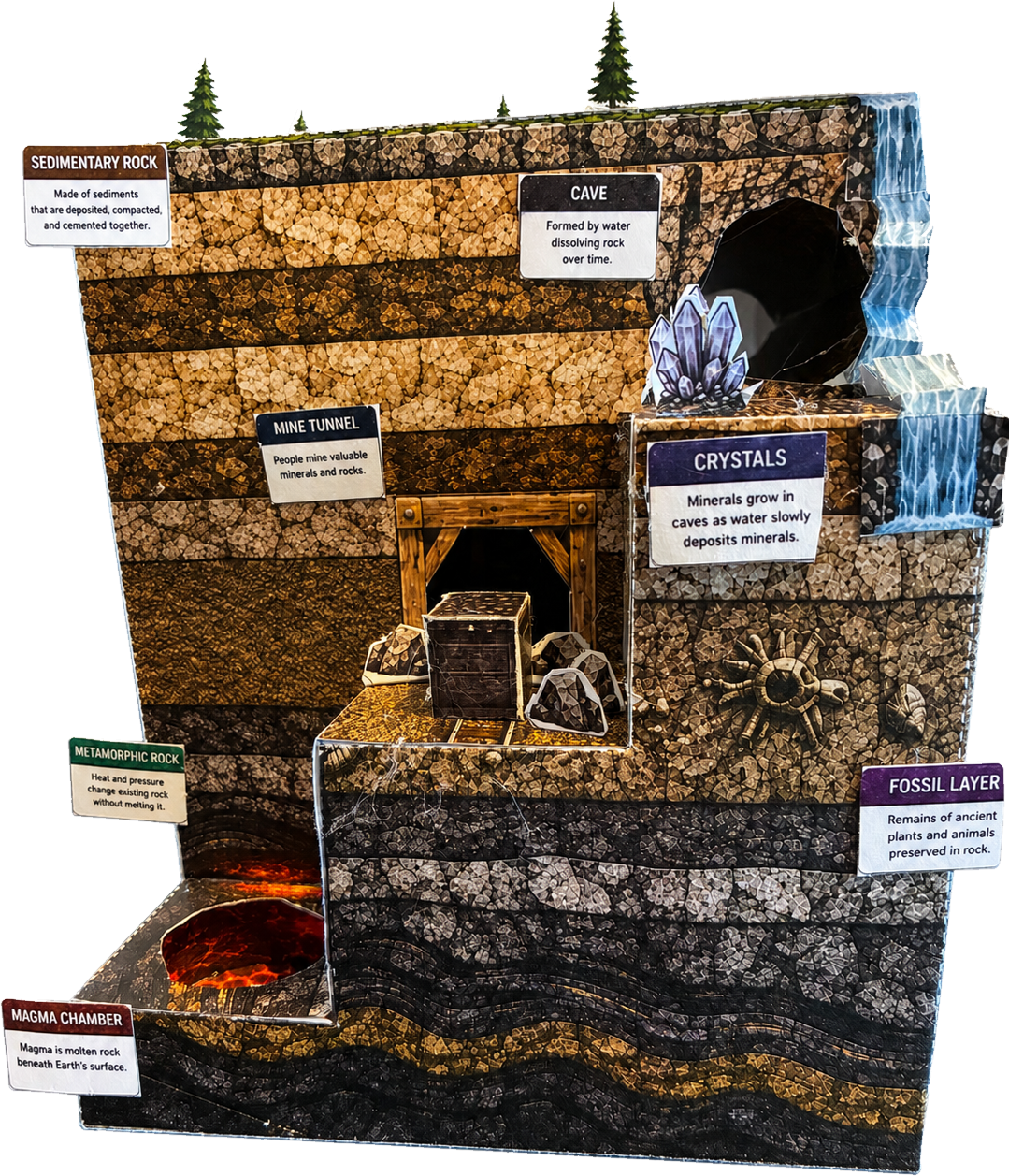
The completed model shows a realistic mountain landscape on top, with a volcano, trees, erosion channel, and surface features, while the cutaway walls reveal the underground story of the Earth, including sedimentary layers, metamorphic rock, fossils, minerals, cave formation, mine tunnel exploration, and molten magma beneath the surface.
Students can use the model to explain how magma cools into igneous rock, how wind and water cause erosion and move sediments, how layers of sediment become sedimentary rock, how heat and pressure create metamorphic rock, how fossils are preserved in rock layers, and how Earth’s materials continue to cycle through natural processes over time.
Parents love this kit because it helps turn a stressful school assignment into a clear, creative, and organized project, while teachers love that it gives students a visual way to explain vocabulary, processes, cause and effect, and Earth Science concepts in a way the whole class can understand.
Instead of searching for cardboard, clay, foam, paint, rocks, labels, and last-minute project supplies, students can print, cut, fold, glue, and build a complete 3D rock cycle display with detailed textures, educational labels, realistic geology artwork, and a finished presentation-ready look.
This kit is perfect for upper-elementary and middle-school students studying the rock cycle, Earth’s layers, landforms, fossils, volcanoes, weathering, erosion, minerals, caves, mining, geology, and natural processes that shape the Earth.
What Students Learn
Students learn how the three major rock types are connected through the rock cycle and how Earth’s surface and underground forces work together to create new landforms, expose rock layers, preserve fossils, form minerals, and reshape the planet over long periods of time.
What Makes This Kit Special
The model combines a volcano, river erosion, waterfall, cave, crystal formations, fossil layers, mine tunnel, rock strata, and magma chamber into one exciting classroom display, giving students a complete visual story rather than a simple diagram.
Great For
Science fair projects, Earth Science reports, rock cycle assignments, geology lessons, STEM classrooms, homeschool science units, volcano projects, fossil studies, hands-on learning activities, classroom displays, and creative school presentations.
Product Format
This is a printable paper model kit designed to be printed, cut, folded, glued, assembled, and displayed as a finished 3D school project.
🌟 Welcome to Paper Models Online – Your Shortcut to Academic Excellence! 🌟
Are you tired of stressing over last-minute school projects? Look no further! Paper Models Online is here to make your academic life a breeze.
🚀 Why Choose Us?
At Paper Models Online, we understand the pressure of looming deadlines and the desire for that coveted "A" grade. That's why we've crafted the perfect solution for you! Whether you're a student aiming for extra credit, a parent looking for quality time with your kids, or just someone in need of a break from the chaos, our paper models are your ticket to success!
💻 Instant PDF Download OR Pre-Printed & Shipped
You're in control! Choose from our instant PDF download, starting at just $9.95 for the 7"x10" size or $11.95 for the 10"x13" size.
Print it on your home or office printer using regular paper, or opt for the hassle-free pre-printed option. We'll ship it directly to your doorstep for a flat fee via USPS First-Class Parcel, ensuring you get it in 1-3 days!
✂️ Easy Assembly, Maximum Impact
With just a pair of scissors, some glue, and an hour of your time, you can turn these paper sheets into stunning three-dimensional architectural replicas or complete science projects. The images on our website are real models made from our kits, and we even provide a history to help you craft an impressive report.
🎨 Unleash Your Creativity
Not into mission kits? No worries! Our models double as templates for your creative genius. Paint, trace, adjust sizes—your imagination is the only limit! Create a custom masterpiece that reflects your unique style and personality.
🛒 The Buying Process Made Simple
- Choose Your Size: 7"x10" or 10"x13"
- Choose Your Delivery: Instant PDF download or pre-printed and shipped
- Purchase Your Model: It's that easy!
📦 Typical Kit Sample
Each kit includes 8 to 18 pages, providing everything you need to bring the model to life. An "exploded view" guides you through assembly, and a complementary history adds that extra touch for your report. Impress your teacher not just with creativity but also with your research skills!
Don't let deadlines stress you out. Choose Paper Models Online for your next school project, and let us be Your Best Way To Get An "A"!
The Rock Cycle Mountain Report
The Rock Cycle Mountain is a hands-on Earth Science model that shows how rocks are formed, changed, broken down, moved, and formed again through natural processes that happen on and beneath the surface of the Earth. Although rocks may look solid and permanent, they are actually part of a slow, continuous cycle that has been shaping our planet for billions of years. Mountains rise, volcanoes erupt, rivers carve channels through the land, sediments settle into layers, fossils are preserved, caves form underground, crystals grow in open spaces, and heat and pressure deep inside the Earth slowly transform one type of rock into another. The rock cycle explains how all these processes are connected.
The three main types of rock are igneous, sedimentary, and metamorphic rock. Igneous rock forms when melted rock cools and hardens. When molten rock is still beneath the Earth’s surface, it is called magma, and when it reaches the surface during a volcanic eruption, it is called lava. As magma or lava cools, the minerals inside it crystallize and become solid rock. In the Rock Cycle Mountain model, the volcano and magma chamber show where molten rock comes from and how igneous rock begins. A volcano is one of the most dramatic examples of the rock cycle because it brings material from deep inside the Earth up to the surface, where it can cool, harden, and eventually become part of the landscape.
Sedimentary rock forms in a very different way. Wind, water, ice, and gravity slowly break rocks into smaller pieces through weathering and erosion. Weathering is the process that breaks rock apart, while erosion is the process that moves the broken material from one place to another. A river, stream, or erosion channel can carry pieces of rock, sand, mud, and minerals downhill and deposit them in layers. Over long periods of time, these layers become buried, pressed together, and cemented into sedimentary rock. The model shows this process with visible horizontal rock layers, which help explain how sediments can build up over time like pages in a very old book. Each layer tells part of Earth’s history.
Fossils are often found in sedimentary rock because plants and animals can become buried in soft sediments before they completely decay. As more layers form above them, pressure increases, and the remains or impressions of living things may be preserved in the rock. Fossils give scientists important clues about past environments, ancient plants and animals, and how life on Earth has changed through time. In the Rock Cycle Mountain model, the fossil layer helps show that rock is not just material under our feet; it is also a record of Earth’s past. When students see fossils inside a layer of rock, they can understand why geologists study rock formations to learn about ancient oceans, forests, deserts, and life forms that existed long before humans.
Metamorphic rock forms when existing rock is changed by heat and pressure without completely melting. This usually happens deep underground, where rocks are squeezed by the movement of Earth’s crust or heated by nearby magma. The original rock may have started as igneous, sedimentary, or even another metamorphic rock, but under intense conditions, its minerals and texture can change. The wavy, folded layers near the bottom of the model represent metamorphic rock because they show how pressure can bend, squeeze, and transform rock over time. This part of the rock cycle is important because it demonstrates that rocks can change while remaining solid, almost like clay being pressed and reshaped, except the process happens very slowly and under enormous natural force.
Caves and crystals are also important features in Earth Science because they show how water and minerals can change underground spaces. A cave can form when water slowly dissolves certain types of rock, especially limestone, over long periods of time. As water moves through cracks and openings, it can carry dissolved minerals with it. When conditions are right, those minerals may be deposited and slowly grow into crystals. Crystals can form in caves, veins, geodes, and open spaces within rocks. In the model, the cave and crystal formations help show that the inside of the Earth is not empty or inactive. Even underground, water, minerals, pressure, and time continue to shape the rock environment.
The mine tunnel in the model represents the way people explore and use Earth’s natural resources. Mines are built to reach minerals, metals, coal, and other useful materials found inside rock layers. Mining connects geology to everyday life because many of the materials people use come from the Earth, including building stone, metals for tools and technology, minerals used in electronics, and materials used in roads and construction. The mine tunnel also helps students understand why it is important to study rocks carefully. Geologists must identify rock types, understand underground structures, and consider safety and environmental effects before resources can be removed responsibly.
The Rock Cycle Mountain also shows how surface processes and underground processes work together. The volcano and magma chamber represent activity deep inside the Earth, while the river, waterfall, erosion channel, and surface rocks show the forces that shape the land above ground. Erosion carries broken rock away from mountains and high places, and those sediments may later form new sedimentary rock. Sedimentary rock may be buried deeper and changed into metamorphic rock. Metamorphic rock may eventually melt and become magma, and magma may later cool into igneous rock. The cycle does not always move in one perfect circle, but the major idea is that Earth constantly reuses its materials.
This model helps make the rock cycle easier to understand because it turns an invisible, slow-moving process into something students can see in one place. A flat diagram can show arrows and labels, but a 3D model gives students a stronger way to explain how each part connects. The volcano shows igneous rock formation, the rock layers show sedimentary rock, the folded lower layers show metamorphic rock, the fossils show evidence of ancient life, the cave shows water dissolving rock, the crystals show mineral growth, and the mine tunnel shows how people use geological resources. Together, these features create a complete picture of Earth in action.
The rock cycle is important because it explains how Earth’s surface is constantly changing, even when those changes happen too slowly for people to notice in everyday life. Mountains may seem permanent, but they are worn down by weathering and erosion. Rivers may look small, but they can carve valleys and move huge amounts of sediment over time. Volcanoes may erupt suddenly, but they are part of a larger process that brings material from inside the Earth to the surface. Rocks may appear ordinary, but each one has a history shaped by heat, pressure, water, time, and movement. By studying the rock cycle, students learn that the Earth is not still; it is active, changing, and connected through powerful natural systems.